
Quotes
Prepare a clear offer for your customer, including the items, prices, validity period and terms. Keep unfinished work as a draft, revise an offer when needed and carry it forward into the next sales document when the customer is ready.
A quote is an offer. Saving a quote does not issue an invoice or record a customer payment. Use the relevant sales document when the offer moves forward.
Find a quote
In the sidebar, open Sales and click Quotes. The Sales Quotes page has two tabs:
- Quotes: review saved quotations, including their date, Quote#, Reference#, customer, status and amount.
- Drafts: return to quotations saved as unfinished work.
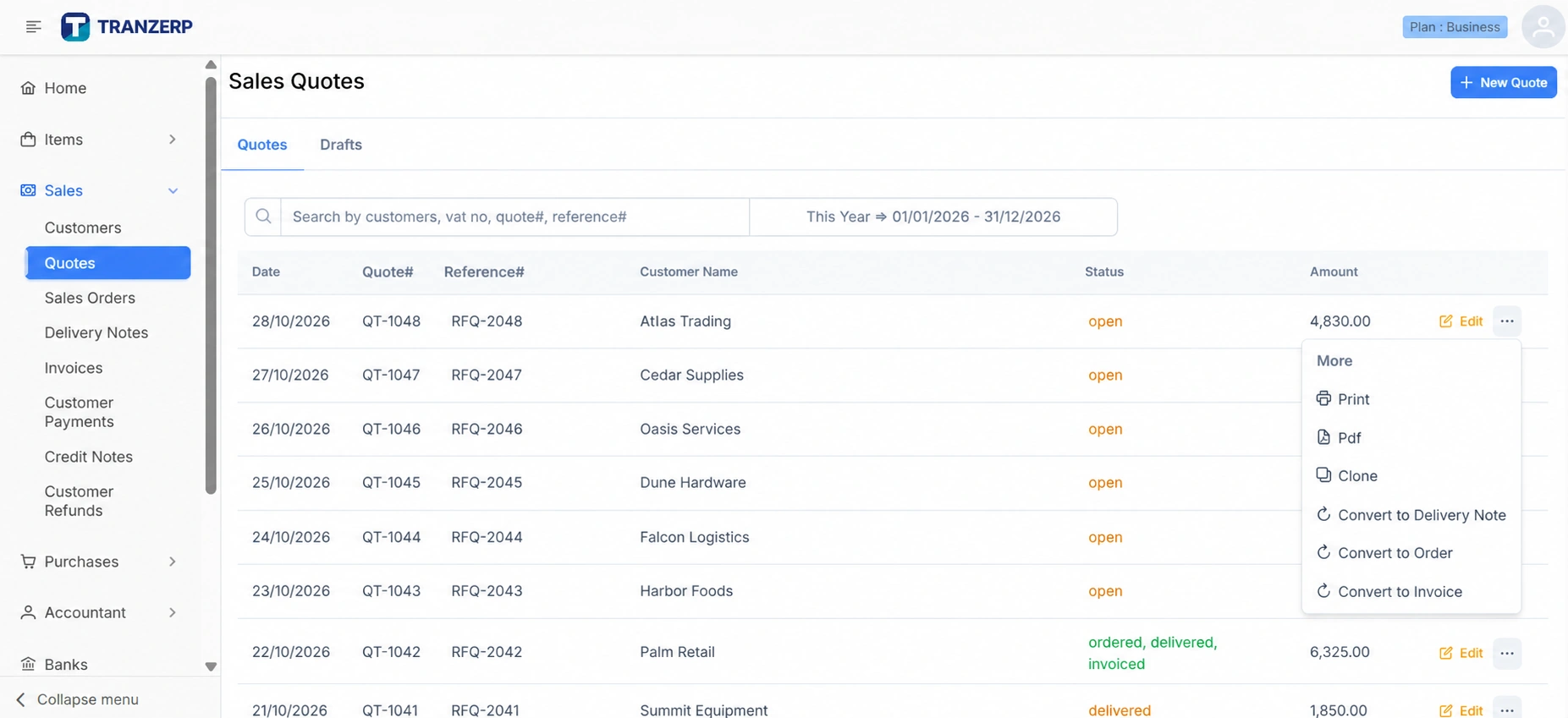
Search by customer, VAT number, quote number or reference. Review the date filter if the quote is outside the displayed period. The example shows This Year; a quote from another period may not appear until you change the filter.
Compare the customer, Quote#, date and amount before opening a record. Click Edit to review its details, or open its three-dot menu for more actions. To start a new offer, click + New Quote at the top right.
Create a quote
Click + New Quote, choose your customer and enter the offer details. Fields marked with an asterisk need attention before you save the completed quote.
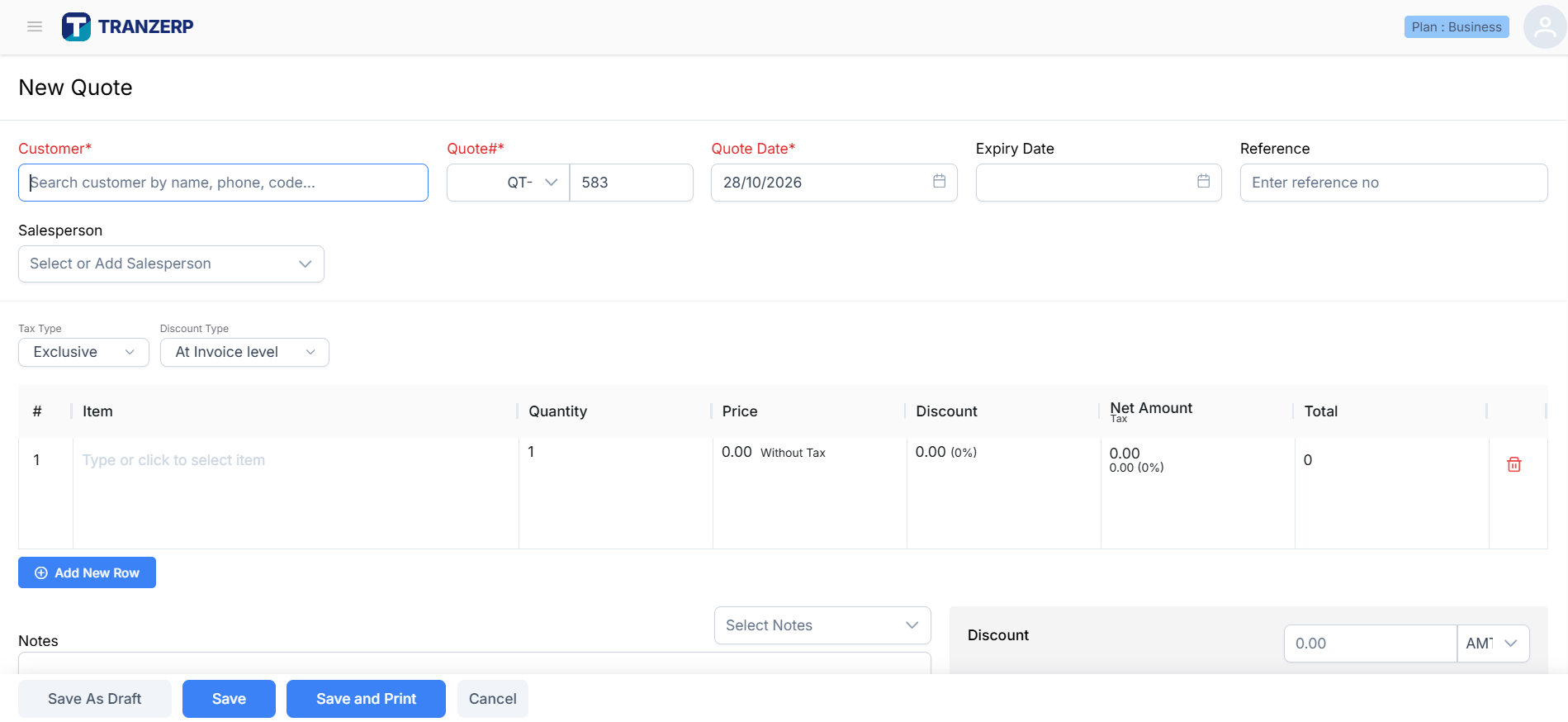
| Field | What to enter or check |
|---|---|
| Customer* | Search by customer name, phone or code, then select the correct customer. Compare their details when names are similar. An inactive customer cannot be selected for a new quote; reactivate the customer first if you are resuming business with them. |
| Quote#* | Review the quote prefix and number. This identifies the quotation in your records; the form shown uses QT-583. Keep it separate from the customer’s reference and the numbers of any later sales documents. |
| Quote Date* | Enter the date of the quotation. Check it before saving, especially when preparing an offer for a different day. This date also helps you find the quote using the list’s date filter. |
| Expiry Date | Enter the date until which your offer is valid, when applicable. This is the quote’s validity date, rather than the due date for an invoice payment. Review expired offers before reusing their prices or terms. |
| Reference | Enter a related enquiry, request or internal reference, such as RFQ-2048. Use a reference that helps your team match the offer to the customer’s request. Leave it blank when no reference applies. |
| Salesperson | Choose the salesperson responsible for the offer. The field lets you select or add a salesperson. Check the selection when another team member prepares the quote on their behalf. |
Check validity before proceeding. An expiry date tells your team how long the offer is intended to stand. If the customer returns after that date, review availability, prices and terms before confirming the next step.
Need to create or update the customer? Read the Customer guide →Items, tax & totals
- Click the Item field and select the product or service you want to quote.
- Enter the Quantity, review the Price and check the row’s discount, net amount, tax and total.
- Click Add New Row for another item. Use the row’s red delete icon to remove an item that does not belong in the offer.
| Field | What to check |
|---|---|
| Item | Choose the product or service you are offering. Check that the selected item matches the customer’s request. |
| Quantity | Enter the number of units being quoted. Review each row separately when the offer includes several items. |
| Price | Review the selling price per unit and whether it includes or excludes tax. Adjust it to the price agreed for this offer. |
| Discount | Check any discount applied to the row, including its displayed amount or percentage. Review it alongside the quote’s Discount Type. |
| Net Amount & Tax | Review the row’s net amount and the tax amount and rate displayed beneath it. Check these after changing a quantity, price or discount. |
| Total | Check the final amount for the row, then compare the combined items with the quote’s overall totals. |
- Tax Type
- Check whether your quoted prices include or exclude tax. The screenshot uses Exclusive, where tax is added to the applicable net amount. Review the selected setting before comparing your offer with a tax-inclusive price.
- Discount Type
- Choose how the offer’s discount is applied. The screenshot shows At Invoice level, which places the overall discount at the document level even though you are preparing a quote. Review row discounts and the overall discount together.
- Discount
- In the totals area, review the discount value and its amount or percentage setting. The example shows AMT for a fixed amount. Check that the result matches the offer you intend to make.
- Totals
- Review Taxable Amount, Total Tax and Total Amount after entering the items and discounts. The final amount is the offer’s quoted total, rather than a record of money received.
For example, 2 items at 100.00 each give 200.00 before discount. With a 20.00 discount and an illustrative 15% exclusive tax on the remaining 180.00, tax is 27.00 and the total is 207.00. Use the prices, discounts and tax settings that apply to your offer.
Removing a row changes the offer. Its item and amount are excluded from the quote when you save the change. Review the remaining rows and final total before saving.
Notes & terms
Scroll below the item rows to complete Notes and Terms & Conditions. Use these to make the offer clear before giving it to the customer.
- Notes
- Add information specific to this offer, such as what is included, an estimated lead time or a collection instruction. Use Select Notes to choose an available saved note, then review it for this customer.
- Terms & Conditions
- Enter the agreed conditions for the proposed sale, such as delivery arrangements, payment terms or exclusions. Use Select Terms for an available saved set and check that it fits the current offer.
Keep the written validity terms consistent with the Expiry Date. If you clone a previous quote, review its notes and terms along with the items and prices.
Learn how to set up reusable notes and terms →Save or keep a draft
Review the customer, quote number, dates, salesperson, items, discounts, tax, notes, terms and final amount. Then choose the action that matches the stage of your offer.
- Save As Draft
- Keep the quote as unfinished work so you can return to it from the Drafts tab on the Sales Quotes page. Review and complete the draft before saving the final offer.
- Save
- Save the quotation for later review and use. Find it in the Quotes tab using its customer, Quote# or reference. Saving the quote does not by itself mean the customer has accepted it.
- Save and Print
- Save the quotation and proceed to prepare a printed copy. Review the document’s customer details, items, amounts, validity and terms before printing.
- Cancel
- Leave the form without saving the current changes. Unsaved entries will need to be entered again. This button leaves the form; it is not an action for cancelling the status of an already saved quote.
If a validation message appears, complete or correct the indicated fields and save again. Check for an existing saved record before starting another quote for the same offer.
Edit or clone a quote
Update an existing offer
- Find the quote in Sales → Quotes, checking the customer and Quote#.
- Click Edit beside its row and update the required details.
- Review the expiry date, items, prices, discounts, tax, notes and terms, then click Save.
Editing updates the saved quote when you save your changes. If the customer already has a printed or PDF copy, prepare an updated copy so they can review the revised offer.
Use a quote as a starting point
Open the saved quote’s three-dot menu and use Clone for a similar new offer. Review the customer, quote number, dates, items, quantities, prices and terms before saving the new quote. Cloning starts another offer; it does not update the original quote.
Check related documents separately. If an order, delivery note or invoice has already been created from the quote, review that document before making changes. Do not assume that editing the quote rewrites documents already created from it.
Print & PDF copies
Find the saved quote and open its three-dot menu to access the print or PDF action. You can also use Save and Print while preparing the quote.
Review the customer, quote number, date, expiry date, reference, items, quantities, prices, discounts, tax, total, notes and terms in the customer copy. Confirm that the content matches the offer before printing or saving a PDF for sharing.
A copy reflects the offer when it was prepared. If you later revise the quote, prepare a new copy. Printing or obtaining a PDF does not create an invoice or record payment.
Learn about document PDF appearance →Convert a quote
When the offer moves forward, use the saved quote’s three-dot menu to choose the conversion for the next document you need. Review the quotation and any documents already created from it before proceeding.
| Convert to | When to use it and what to review |
|---|---|
| Sales order | Use when the customer accepts the offer and you want to record the agreed order. Review the customer, items, quantities, prices and any delivery details before saving the order. |
| Delivery note | Use when you need delivery paperwork for the quoted goods. Check the items and quantities to be handed over, the customer and the delivery details before saving. |
| Invoice | Use when the sale is ready for billing. Check the customer, invoice date, due date, items, prices, discounts and tax before saving the invoice. |
Review the details carried into the next document and complete its required fields before saving. The quote’s number identifies the offer; use the new document’s own number when tracking that order, delivery note or invoice.
Avoid recording the same sale twice. Check the quote’s status and related records before converting it again or creating a separate document manually. Conversion is a next step in the sales workflow; it does not record a customer payment.
Continue with the Invoice guide →Understand quote statuses
Review the Status column in the Quotes tab to see how the quotation has progressed. The list can show more than one stage together, such as ordered, delivered, invoiced.
- Open
- The quotation is open. Review the offer and any customer response before deciding its next step. An open quote is not evidence that a payment has been received.
- Ordered
- The quotation has progressed to the order stage. Review the related sales order for the agreed items, quantities and order details.
- Delivered
- The quotation has progressed to the delivery stage. Review the related delivery document and your delivery records for the handover details.
- Invoiced
- The quotation has progressed to billing. Review the related invoice for its amount, due date and payment status. Invoiced does not mean paid.
The Drafts tab is for unfinished quotes. Use it when searching for work saved with Save As Draft, rather than looking only in the Quotes tab.
Troubleshooting
I cannot find a saved quote.
Review the Quotes and Drafts tabs, clear or adjust the search and check the date filter. Search by customer, VAT number, Quote# or reference. Check that you are in the correct workspace.
My customer is missing from the selection list.
Search by their name, phone or code. If the customer is inactive, reactivate them before creating a new quote. Check the Customer guide if you need to create or update their record.
The total is different from the offer I intended.
Check the selected items, quantities, unit prices, row discounts, overall discount and Discount Type. Review whether prices include or exclude tax, then compare Taxable Amount, Total Tax and Total Amount again.
The quote’s expiry date has passed.
Review the offer with your team before proceeding. Confirm prices, availability and terms, then update the quote and its expiry date if the offer is being renewed. Prepare a revised copy for the customer.
I changed a quote after creating an invoice from it.
Review the invoice separately. Do not assume the saved invoice has changed to match the quote. Check any other related documents before making corrections so the records remain consistent.
I cannot save the quote.
Check the customer, quote number and quote date, then follow the validation message for any missing or incorrect fields. Review the item rows and amounts before trying to save again.